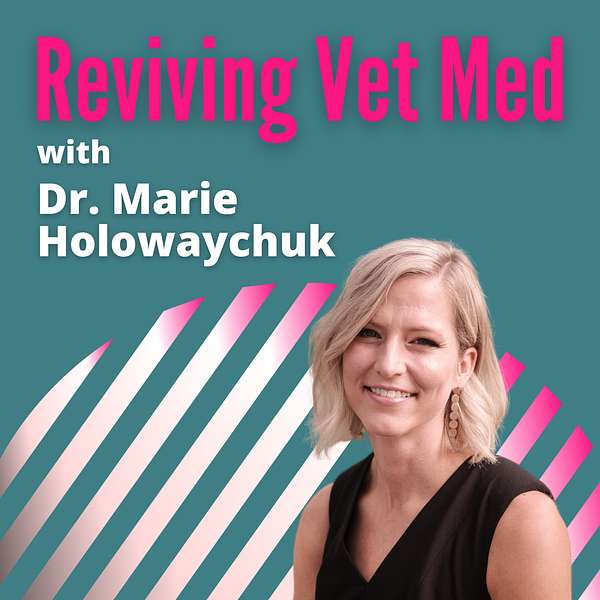
Reviving Vet Med
Join Dr. Marie Holowaychuk, board-certified small animal emergency and critical care specialist, as she explores the world of mental health and wellbeing, as it relates to veterinary professionals.
Reviving Vet Med
Bonus Episode: What It Really Means to Be a Veterinarian | Episode 80 | Reviving Vet Med
In this special bonus episode, Dr. Marie Holowaychuk shares her recent conversation with Dr. Andy Roark from the Cone of Shame podcast, diving into the heart of her new book, A Compassionate Calling: What It Really Means to Be a Veterinarian. Together, they explore the emotional realities of veterinary medicine, from perfectionism and burnout to purpose, identity, and rediscovering joy in the work.
Whether you’re a veterinarian, technician, student, or someone who loves a veterinary professional, this episode offers a candid, compassionate look at what it truly means to build a career in a caring profession without losing yourself along the way. If you’ve ever struggled to balance passion with personal wellbeing, or wondered how to set boundaries without guilt, this conversation will feel both validating and deeply hopeful.
Tune in for an honest discussion that reminds us why the work matters, and why caring for ourselves matters just as much.
Resources
Learn more about A Compassionate Calling: What It Really Means to Be a Veterinarian and order your copy: https://ACompassionateCalling.com
Follow Dr. Andy Roark on social media: @DrAndyRoark
Follow and listen to the Cone of Shame podcast: https://drandyroark.com/podcast/
Newsletter
For more practical pointers and tangible tips related to veterinary mental health and wellbeing, subscribe to our e-newsletter: https://revivingvetmed.kartra.com/page/newsletter
Reviving Veterinary Medicine Resources
To explore our RACE-approved online programs, handouts & posters, podcast episodes, blogs, and upcoming events, visit: https://revivingvetmed.com. This is your hub for free resources, 1-on-1 coaching, lunch & learns, critical incident debriefing, and everything Reviving Veterinary Medicine has to offer.
Questions, Suggestions, or Sponsorship Opportunities
Email: podcast@revivingvetmed.com
Dr. Marie Holowaychuk - This episode is brought to you by Reviving Veterinary Medicine Your go to resource for evidence based tools and support that put mental health and wellbeing at the center of veterinary practice. Whether you're a veterinarian, technician, assistant or manager, our free resources like blogs, downloadable handouts and podcast episodes are designed to help you thrive, not just survive in your role. And if you're looking for more personalized support, we also offer services like One one Coaching by Certified Veterinary Professionals, Lunch and Learns led by experienced facilitators and critical incident group debriefings guided by trained experts because your wellbeing matters and sustainable veterinary careers. Start with support that's practical, professional and deeply personal. Visit RevivingVetMed.com to learn more and explore what's possible when we put people first in vet medicine.
Dr. Marie – Welcome to another episode of Reviving Vet Med. Today's episode is one of our special 10th episodes and is a bonus replay of a conversation that means a lot to me personally. I recently joined Dr. Andy Roark on his cone of Shame podcast to talk about my new book, A Compassionate Calling: What It Really Means to Be a Veterinarian. Andy and I go deep into the emotional landscape of our profession. Why so many of us struggle with perfectionism, burnout and feeling never enough and how we can begin to reclaim joy and self compassion in this career that we care so deeply about. If you've ever wondered how to balance purpose with peace, or if you've felt the weight of trying to hold everything together for your patients, clients and team, this conversation will speak straight to your heart.
Dr. Marie – Andy brings his signature curiosity and warmth as well as humor and together we explore what it really means to be a veterinarian behind the exam room door. I'm really excited to share this conversation with all of you, so let's go ahead and get into this bonus episode. This is the Reviving Vet Med podcast and I'm your host, Dr. Marie Holowaychuk. My mission is to improve the mental health and wellbeing of veterinary professionals around the world.
Dr. Andy Roark - Welcome everybody to the cone of Shame Veterinary Podcast. I am your host, Dr. Andrew Roark. Guys, I got a really good one today with my good friend Dr. Marie Holowaychuk. Marie, if you do not know her, she's a force of nature when it comes to wellness and wellbeing in veterinary medicine. She is a boarded emergency and critical care specialist and she has a new book called A Compassionate: What It Really Means to Be a Veterinarian and this book is out now. You can get it wherever you get your books. We'll put links in the show note for where you can find a copy. But honestly, wherever you get your books, you should be able to find it. Marie is a fascinating person.
Dr. Andy – I start to talk to her about her book and also kind of about her life and the lessons that she learned that brought her to this. And very much about what are the problems, what are the struggles, what are the concerns? And guys, she does a really great job in her book of tying in her personal story and journey as a veterinarian and a specialist and a type A perfectionist ladder climber who burned out and burned out really hard and the lessons that she learned and how she sort of readjusted and went from there. And she ties that together really nicely with great research on the vet profession, on wellness in the vet profession. And then she ends the book with this really nice sort of hopeful part about the future of veterinary medicine. Where does she think it's going?
Dr. Andy – And so what are the challenges, but what are the opportunities ahead? And so anyway, there's a lot in this book. It is sprawling, it covers a ton of topics. The way I think about it is one, it's great for any veterinary professionals that are interested in wellness and wellbeing. But two, if you know anyone who really wants to understand veterinary medicine and the wellness side of veterinary medicine, you know who I'm talking about. The people who have said, I have heard that, you know, there's a high suicide rate in veterinary medicine and people need to be nicer to their veterinarians and they want to be supportive. They would really like to sort of understand more what the profession is really like on the wellness side. This is a phenomenal book for those people.
Dr. Andy – So anyway, guys, I'm gonna stop talking about it and just show you the interview. Marie Holowaychuk, let's get into this episode.
Dr. Marie – This is your show. We're glad you're here. We wanna help you in your veterinary career. Welcome to the cone of Shame with Dr. Andy Roark.
Dr. Andy – Welcome to the podcast. Dr. Marie Holowaychuck, how are you, my friend?
Dr. Marie – I am wonderful, Andy. Thanks so much for having me.
Dr. Andy – I love having you on here. So you are so fascinating to talk to. I just love whenever I get to spend time with you. You are such an interesting person. You are such a deep thinker. For those who do not know you are a veterinarian, you are an emergency critical care specialist. You still practice. You are the founder of RevivingVetMed.com, which we'll talk about here in a second. And you have a new book out. It is called A Compassionate Calling. And I was so fortunate. I got a pre-release copy and got to see this thing. And it is incredible, Marie. It's just like it is so well done and it is so robust. I mean, you have got so many topics that you get into and that you talk about.
Dr. Andy – And we'll sort of start to talk about this in a second, but let me sort of pause here for a second and sort of psych. Tell me real quick about Reviving VetMed.com for people who aren't familiar with it.
Dr. Marie – Yeah. So a few years ago, I wanted to put together a hub of resources to help veterinary professionals when it comes to their mental health and wellbeing. And so it started out as a hub for some blog posts and some podcast interviews and episodes, and it's just grown from there. So there are a ton of resources. There's downloads, things that you can share with your team, things that you can post in your break room if you have a question. For example, how do I find the right counselor for me? If you search it on the website, you'll have a blog post or a podcast episode that comes up to help. And then this past year we've expanded so we have veterinary specific coaches that offer coaching in different areas. They all have experience either as veterinary professionals or working with veterinary professionals.
Dr. Marie – So we have an ADHD coach, a menopause coach around resilience coaches, helping people who are moving just freshly into leadership roles. And then we also offer critical incident debriefing. So if you or your team mostly have an incident that really doesn't sit well with the team, really shakes people up. Maybe there's just a significant issue with an angry client or something that escalates. This is a way that we can come in and facilitate a formal debrief with the group to help reduce any sort of distress after any post traumatic stress disorder, anything like that. And then we also offer lunch and learn. So if people are looking to support their teams with just a little bit of information that they can digest over a lunch hour, we've got great facilitators for that as well. So lots of resources. Yeah. That we offer.
Dr. Andy – That's very cool. Why did you call it Reviving Vet Medicine? So you're a criticalist. Reviving means something specific. Talk to me about that because I think it leads into your book in a way.
Dr. Marie – Yeah, I'm so glad that you asked that. I think it's kind of a little tongue in cheek thing, because I am a criticalist, like you said. So I spend so much of my time reviving animals, bringing them back from the brink of death, shock, sepsis, whatever it might be. And I have seen such a change in our profession over the last few years. And Andy, I know you and I have talked about this a lot and you feel the same way. You and I both share this real passion for our profession. We love what we do, we love vet medicine. And a few years ago, I was really surprised to read some findings that came out of the very first Merck Animal Health Wellbeing Study that showed that less than half of veterinarians would recommend this profession to a friend or a family member.
Dr. Andy – Yeah.
Dr. Marie – And I thought, how can that be? Everybody wants to be a vet. Like, every time I tell somebody I'm a vet, they're like, oh my God, I wanted to be a vet. And for whatever reason, lots of different reasons, people say they didn't or they couldn't. And I am so proud of that. I love that. And it just makes me so eager to tell people all about it. And I'm not talking about the profession with rose colored glasses. I know that we have our challenges, and as a wellbeing advocate, I speak to those a lot.
Dr. Marie – And I think we've reached a point, many of us in this profession where we've sort of kind of thrown our hands up and just said, well, vet med is actually really bad and it's really hard and people don't understand and our clients are just really terrible to us and we've just got these high suicide rates and that's just the way that it is. And almost like identifying with it and, or accepting it just as it is, like a normalization of a pathology, almost like it's just normal. We're going to burn out. It's just normal. We're going to have mental health challenges. And you know, of course we're human. These experiences are normal. But just because we're in vet medicine doesn't mean they are inevitable. And so I want to get us back to a place where we were or. Yeah, we can't turn back time.
Dr. Marie – We can't take away the pandemic. We can't reverse all the changes and advancements that we've had. But can we get ourselves back to a place of happiness, joy, pride, excitement, thriving? Dare I say so that really is the revival that I'm hoping for.
Dr. Andy – I love that picture of like the septic patient being revived. That speaks to me. Such a great answer. I thought that you had thought it through and I was sure that there was a good answer. And I was right. That's amazing. Talk to me about your book, A Compassionate Calling. So I think that weaves right into sort of this larger philosophy that you've kind of started to lay down and what your sort of goals are. But talk to me a bit about what the book is about and what did you hope to accomplish with it.
Dr. Marie – So the subtitle is what it really Means to be a Veterinarian. And it has so many different layers to it. I wrote the book, or had the idea to write the book after I read that stat that I shared from the Merck Animal Health Study. And just reflecting back on my journey in our profession, I have spent time in academia, in private practice, corporate owned practice, general practice, working with industry, et cetera. And I feel that there is so much to unpack underneath our experiences that many of us in our profession still don't fully comprehend. I'll go back to what I said before, which is this almost throwing up our hands and saying it's just really hard what we do and that's it. But not being able to put a name to that. Why is it hard?
Dr. Marie – What is hard about what we do in the social work sphere, we often use this phrase, you know, name it to tame it, right? Naming our experience. If we can name what burnout is and identify it, then we can recover from it. If we can identify, yeah, the work is hard because we experience a lot of ethical dilemmas or moral stress, then I can actually take action and do something about it. And so a lot of it came from this desire to validate and describe and explain with evidence and stories what we go through as veterinarians on a daily basis. And so like you said, there's so many different chapters around everything from the journey that we go through to become a veterinarian. How do you get into vet school? What is vet school like? How much does it cost?
Dr. Marie – What do we make as graduate new veterinarians? What are the different pathways that we can take in this profession? And then what are all the challenges along the way with our clients, with our teams, with our cases that we see with euthanasia, with perfectionism, with mistakes? I unpack it from an individual veterinarian perspective and then from a profession perspective, right from the entire team. And I wanted so much to bring this information to the pet owning population as well, because I think you have probably had the same experiences as me where you get on an airplane, heaven forbid you tell somebody you're a vet, because it opens up a whole conversation for the rest of the airplane ride. And now you're kind of enlightening to them as to what it is that we do and what our life is really like.
Dr. Marie – And I felt like I was having these same conversations as a wellbeing advocate over and over again about the challenges that we experience. And I don't want that to be the focal point because we have so many joys in our profession as well. But I do see a growing divide between our clients and our veterinary teams that I would love to see bridged. I would love to see better understanding on both sides, both better self awareness on the part of the professionals and better awareness of the profession on the part of our clients so that we can start to come back together and work together. Which is what is so important, of course, is so much of what you teach when you teach your client communication.
Dr. Andy – When I talk to people who have written books, they usually tell me they've written them for one of two reasons. They say, either I wrote this because I had a message that I really wanted to communicate, I had something I wanted to get off, or the other thing they tell me is they say I wrote this because I really wanted to organize my own thoughts. You know what I mean? I wanted to really take these things that I think a lot about and try to just organize them or understand how that fit together for myself. Marie, does one of those speak more strongly to you?
Dr. Marie – Yeah, for me, it's the former. It's sharing the message. I'm a second generation veterinarian. Both of my parents are vets. I love this profession so much. I feel like it's literally in my bones, it's in my genetics. And I would love nothing more than for my daughter to become a veterinarian. Truthfully, I want to see people love this profession as much as I do and be able to sustain themselves in it. And so part of it was written for them, for those of us in this profession, and to help them as well. Because I feel like so many veterinarians are like, if clients would just understand what it is we go through. And I don't believe in kindness campaigns. I don't believe that clients are the root of all evil in our profession.
Dr. Marie – I don't think it's helpful to tell clients we have really high rates of suicide and you need to be nicer. Like, I don't believe that rhetoric. I think it's harmful. However, I do think that empathy helps everyone. When people really can put themselves in someone else's shoes and understand what they're going through. Whether that's an unhoused person or the barista at Starbucks that's trying to pay off their student loans, or our neighbor that's going through a separation, or your vet that you're going to an appointment with, that makes a big difference in how we connect and how we communicate with each other.
Dr. Marie – And so if I can help the general pet owning population to understand just a little bit more about what we did to get where we are and what we go through on a regular basis and what the future holds for us, then I think it's going to better for everybody.
Dr. Andy – You cover a lot in this book. I think you did a really great job of presenting the research and also interweaving your own stories and your own thoughts. It's almost like having somebody walk you through the research, which I think is an add sort of their own color and commentary. And so I really enjoyed that part of this. As I said, this is a robust book. And you talk about a lot of different topics around burnout, around student debt, around corporation, around changing work dynamics, gender and dynamics, all of these sorts of things in the book. And my question, I guess, for you is when you think about all of the different pieces that go into this, which pieces are you most proud of? Do you have some that you say this is? I'm really happy that I talked about this.
Dr. Andy – And also, which ones do you think are most important?
Dr. Marie – I really am proud of the way that I was able to incorporate the evidence with the storytelling. I think specifically around the chapters that are on veterinarian specifically. There are so many really personal stories that I share. I mean, I share a story about a dog who died under our care in the ICU when I was a resident because I misinterpreted a radiograph and the dog's feeding tube was misplaced. And that is in my story, my chapter on mistakes. And I talked to so many vets. I talked to one vet this morning, incidentally, who made a mistake back in 2015, and it still haunts her to this day. And I mean, Lacey, this dog that I cared for, she died back in. It was 2006 or 2007. And I remember that as if it was yesterday.
Dr. Andy – Yeah.
Dr. Marie – And so I tell that story to normalize the fact that we all make mistakes. And sometimes those mistakes result in death. And here's all the things that the research has shown us about what sort of mistakes happen, why did they happen? What can we do to recover from them? What is important for us to communicate to clients in those circumstances, because there's that whole piece of it as well. There's a whole family that loved that animal that died or was harmed as a result of that. So it's sharing those stories that I know are going to so deeply resonate with people in our profession that they're going to connect with and feel not alone, feel validated, feel normalized in their experiences, and be able to have evidence based information as to what to do with that, what that really means.
Dr. Marie – And then I hope when pet owners read that, they will also be able to see how much we care, how deeply we grapple with these situations as well. I think those particular chapters about my own mental health challenges, my own cases that I've grappled with, my own situations of ethical distress that kept me up at night, I think those were really important to share. I think what is most important is where we take this information moving forward. So the latter portion of the book is a series of chapters on where we go from here. And a lot of it includes those topics that you shared. Corporatization, pet health insurance. What does that mean for the future of our profession, our curriculums?
Dr. Marie – We have a lot of new vet schools, we have a lot of new ways of training students, we have a lot of decisions to make in terms of what we want our students to graduate knowing and understanding. And what are we really doing to take care of the people in this profession? Because without the people, we don't have a profession. And so I think those are the chapters that I'm really interested to hear what people think and what, if any, collaboration or next steps come from that.
Dr. Andy – Yeah, so you've got, there's a section of your book, it's sort of part three of this four part sort of structure that you have. You talk about what we now understand about veterinarians. And I went right, I gravitated right to this. You talk about professional identity and then you talk about victimhood and martyrdom, you talk about the challenges of perfectionism. And then that's when you get into veterinary mistakes, which I think you were talking about sort of handling veterinary mistakes. And I just looked at this and this just felt like such sort of a treasure trove to me of sort of this insight of what are the real sort of hardships and stuff. And I think you just weave in lessons learned really nicely.
Dr. Andy – But when you think about what we now understand about veterinarians, and I want you to think about where we are in 2025, what do you think are the sort of the greatest struggles that exist right now? And do you think that those are changing? Do you think it's the same culprits that it was five, 10 years ago? Or do you think that landscape is changing? So, where do you think we are now? And do you think that's static or is it evolving?
Dr. Marie – I do think it's changed a lot. Even the last five years. If we look at pre-pandemic to now, I think it's changed. I think it was already changing before that and I do think it's going to continue to change. I touched on it a little bit already, which is where I think you mentioned martyrdom, the chapter of victim mentality and martyrdom syndrome. I do think, and I see many veterinarians and others in our profession that have found themselves feeling like they're stuck. Yeah, like we are the victims of a profession that for years didn't pay enough and for some of our team members still doesn't pay enough. That our happiness on a daily basis is governed by our clients and how they treat us.
Dr. Marie – And we have to do all these really hard things like perform euthanasia and speak for pets and animals that can't speak for themselves. And yes, at the end of the day, yes, our jobs are so hard and we deal with a lot and I'm not disputing that. And I talk a lot about those challenges and I do think that we need to recognize at this time that a lot of what we are experiencing we do have control over to some degree. Now, of course, this depends on whether you're a practice owner, an associate, a support team member, or who you are in the practice. I'm not speaking to everybody and I'm not discounting the many systemic issues that we have in our profession.
Dr. Marie – I would love to see people look at that which we have control over, how we respond during these times of adversity, how we react to clients when they're not treating us well, what we do when we hear a team member gossiping, whatever it is, and to recognize, okay, we can take steps to make things better. I do have control over some of these things. I have control over myself at the very least, and do something from there. I think we have to change. I think where we are now is not sustainable. And I think a lot of people feel that way. And some of that change has to come from within. Some of that change has to happen within the systems, right within the structures, just within the setup of the day to day.
Dr. Marie – There are many work environments, some of which I have worked in myself. Where what's being asked of individuals just isn't sustainable, it isn't doable, and that is perpetuating burnout in many circumstances, despite individuals really wanting to take care of themselves and better, be healthier.
Dr. Andy – That's a great answer. When I look at sort of this type of subject matter and I think about what it means to be a veterinarian, I think about struggles for veterinarians. I have this habit of grabbing onto problems. And I'll say, well, this is a problem, or this is hard, or this is challenging. And then I start thinking, well, when you stop doing this and you need to not do this, and you need to make sure that you're not getting sucked into this and you really don't want to feel this way, and you need to really not let yourself be put into this position. But I think that's an innate sort of just a negative sort of mindset in a way, to look at it.
Dr. Andy – And so I look at your book and I look at all of the things you've done around wellness, the resources you've written, the articles you've written, the presentations that you've given, the retreats that you run and things like that. What I want to ask you is, you know, having written this book and really thought about the struggles of veterinarians and life and veterinary medicine, if I could have Marie gmail Chuck's Keys to a Good Life, meaning, what are the things that you should do as opposed to the things that you should not do? Are there things that you think, yeah, these are. I don't expect you to have a complete list off the cuff, but what are the things that you would say, these are my sort of keys to a good life and a good career in medicine?
Dr. Marie – I mean, a few things come to mind for sure. I, again, I gravitate towards that which I have control over, which is myself. And one of the challenges that I faced early on in my career, which is what led me to burnout, was that I wasn't setting boundaries for myself. And again, I don't want to sit here and tell people, if you set boundaries and you practice yoga, you're going to be great for the rest of your career. I know it's much more complicated than that, but if we were to start by identifying what we need as individuals, and what I need is different from what you need and from what my colleague needs and everything else. So what do I need to be able to work in this profession?
Dr. Marie – Well, I can tell you a few things I need to work part time in the clinic. I definitely, with my current family structure and my own mental health and everything else, I can't work 40 to 60 hours a week in clinical practice every week. It's not sustainable for me. I've come to recognize that I love clinical practice and there's a limit to what I can do. So I need to be able to have time to do other things, including nurture other passions that I have, such as mental health advocacy and education. We all have limits, right? And we all have needs from various other perspectives, financially, socially, emotionally, physically and otherwise. And all we're doing when we're setting boundaries is making it clear as to what those needs are, right?
Dr. Marie – So if it's that I need to be able to leave by 6 o' clock so that I can have dinner with my kids and get them to bed, because family is one of my core values and is of the utmost importance to me, then we need to be able to communicate that versus going with it, Taking it as if it you have no control over it, and then becoming resentful, frustrated, burnt out, challenges with your family and your happiness because of it. So really being honest with yourself about what you want, what you need and where your limits are and communicating those. And I know the communication piece is one of the hardest pieces and there's people that can help you with that, counselors, coaches, and so on.
Dr. Marie – And I know one of the other hardest pieces is the guilt that comes along with it. And I've experienced that too, where I've had shifts offered to me like, hey, Marie, we really need you. We can't find anybody to work this shift. And I want to say yes. I feel so guilty for saying no. But I recognize if I say yes to this and I show up not the best version of myself, underslept, exhausted, whatever it is, then I'm putting my patients at risk, I'm putting myself at risk, I'm giving up something else. Whether it's time, with my family, my health, whatever. We have to be able to recognize the guilt that it's always going to be there because we care so much about what we do.
Dr. Marie – And put that aside knowing that at the end of the day we have to take care of ourselves. So I think boundaries are one of the biggest things. I think, honestly, if I was to give another recommendation, and this is something I do talk about in the book as well, it would be a whole lot of self compassion. I think so many of us are going through such a hard time in life in general and in our profession for any reason. Right. It could be the clients, it could be the schedules, it could be your short staffed whatever it is rather than pushing yourself through. And I just need to work harder, being that really negative inner critic and just like bulldozing yourself through to just stop and acknowledge a. This is really hard. Like I'm in a really tough spot right now.
Dr. Marie – Work is really hard. My team is going through a lot. The clients have been particularly grueling lately. That's hard. Number two, I'm going to notice that. I'm going to identify it for what it is, but I'm not going to like fixate on it or ruminate on it. I'm going to mindfully be aware that yeah, I'm going through this tough time and then I'm going to let that go. And then the last piece is that self talk, that talking to yourself kindly instead of just like berating yourself. Just get through this. Keep going. You know that sort of coach, that's a little bit harsh. That is trying to propel you forward. You speak to yourself like you would speak to a good friend, right?
Dr. Andy - Wow.
Dr. Marie - Yeah. You're going through a really hard time right now. It's okay. You're gonna get through this. It will get better. It's not always gonna be this hard. So that all those three pieces, the, you know, common humanity, the mindful awareness and the self kindness, those are all the three main components of self compassion. It's been a game changer for me. I tried cognitive behavioral and still continue to do cognitive behavioral therapy, counseling, internal family systems therapy, all of these different modalities. And at the end of the day, my intellectual brain and my type A driven personality benefits the most from that self compassion practice.
Dr. Andy – I think that's fantastic. Marie. Thank you so much for being here. You are so wonderful. Your book is called A Compassionate Calling: What It Really Means to Be a Veterinarian. I will put links to that in the show notes so people can find it. You can get it wherever you get your books now. I mean, you're doing an impressive sort of rollout for it right now. Where can people find you online if they want to kind of keep up with all the things that you're doing?
Dr. Marie – Oh, thank you. I'm very active on Instagram and LinkedIn, @MarieHolowaychuk on Instagram and LinkedIn. Dr. Marie Holowaychuck, you'll find me there.
Dr. Andy – I will link those up as well. Thank you for being here, guys. Thanks for tuning in and listening everybody. Take care of yourselves, gang. We'll talk to you later. And that's what I got. Guys. Thanks for being here. Thanks for checking it out. If you enjoyed the episode, share it with your friends. Like subscribe, leave the reviews. All of the positive things. They actually really do help the show a lot. They help people find us and it means the world to me. Anyway, I just always make that ask. Guys, thanks again for being here. Thanks to Marie. Take care of yourselves, gang. Be well. I'll talk to you later.
Dr. Marie – And that's it for this bonus episode of Reviving Vet Med. I hope this replay of my conversation with Dr. Andy Roark offered something useful. Whether that was perspective, reassurance, or simply a chance to feel less alone in the challenges surrounding vet medicine, A Compassionate Calling was written not just for vet professionals, but also for the partners, friends, family members and clients who want to better understand the realities of this work. My aim is to offer a practical, honest look at what this profession asks of the people inside of it. If you'd like to explore the book further order your copy, you can visit ACompassionateCalling.com It's a helpful resource for colleagues, students, and anyone who supports someone working in Vet Med.
Dr. Marie – You'll also find free tools on the website, including the 10 things your veterinarian wants you to know, client handout and discussion questions for book clubs. Whether you're reading with pet owners or veterinary teams. A huge thank you to Dr. Andy Roark for the generous conversation and for his ongoing support of veterinary wellbeing. Be sure to follow him and check out the cone of Shame podcast if you haven't already. And if you enjoy today's episode, please consider sharing it with someone who might appreciate it. And if you haven't yet subscribed, now's a great time to do that so that you never miss what's coming next. You can also follow along on social media @RevivingVetMed for more tools, insights and updates.
Dr. Marie – As always, if you have questions, ideas or want to explore sponsorship, you can reach us anytime at podcast@revivingvetmed.com until next time, take good care of yourself. Bye for now.